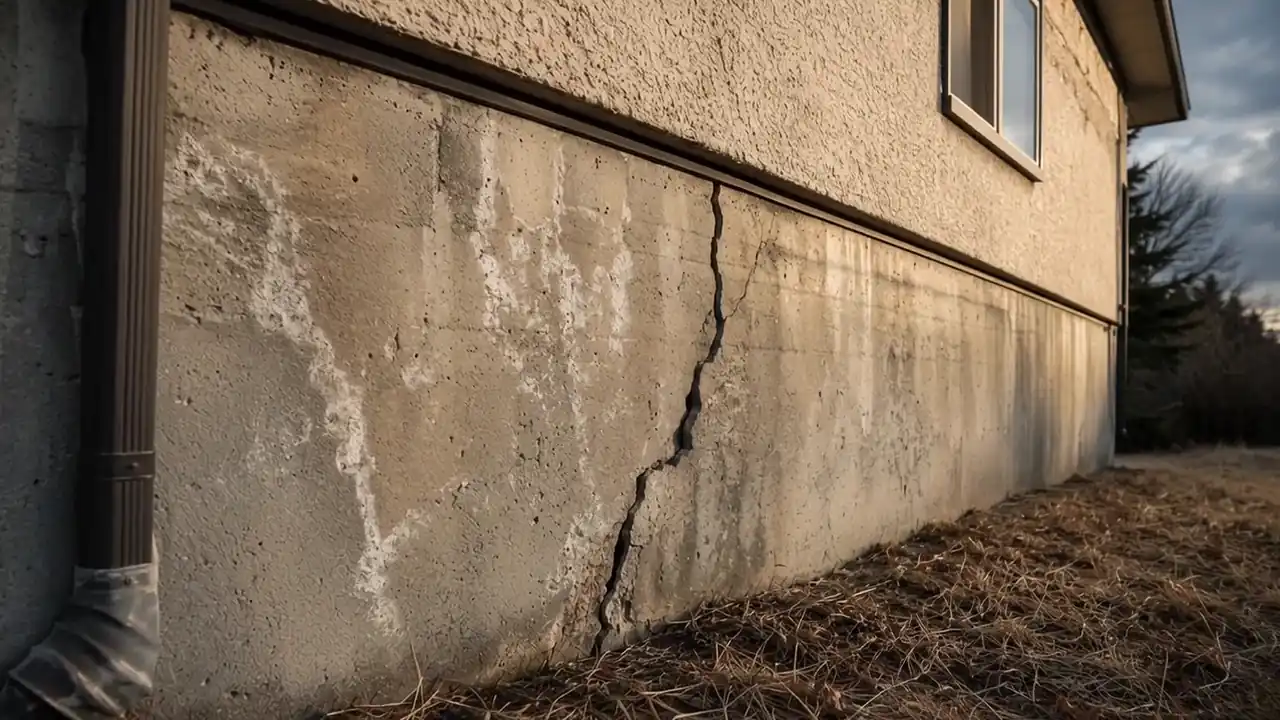
Calgary and Surrounding Area
Foundation Cracks or Basement Leaks in Calgary?
Not sure whether your foundation crack, basement leak, or settling problem needs repair?
Start with a free preliminary foundation problem review. Describe what you’re seeing, upload photos, and get guidance on the information needed to request an assessment.
- Independent Calgary foundation information and referral service.
- No obligation. No confirmed contractor partner currently; no guaranteed assessment, quote, referral, or contractor response.
- Photographs help document problems but cannot replace a professional inspection.
Your enquiry goes to our team first. How this site works
Document the problem before deciding on repairs
Start with what you can see: the crack, where water appears, and whether anything has changed. Photo uploads are optional, and you do not need to provide a full property address.
We are a referral service, not a contractor. There is currently no confirmed contractor partner. Your request reaches our enquiry team, not a booked contractor.
What are you seeing?
Start with the symptom rather than the service. Each answer explains what it usually means before it suggests doing anything about it.
- A crack in the wallWork out whether the direction and width matter
- Water leaking into the basementFind where it is getting in and what to do now
- A wall bowing or leaningHow to measure it and how far is too far
- Floors sloping or doors stickingThe signs that point to settlement
- A horizontal crackThe one crack direction worth acting on
- I am not sureDescribe it and we will pass it to a contractor
Repairs explained
What each kind of foundation work actually involves
Ten repair categories, each with the methods that suit it, what the process looks like, and what drives the price.
Foundation crack repair
I have a crack in my foundation. Can it be repaired, and how?
Foundation wall repair
My basement wall is bowing or leaning inward. What can be done about it?
Foundation settlement repair
Part of my house seems to be sinking. Is that a real problem?
Foundation underpinning
Someone told me my house needs underpinning. Is that really necessary?
Structural foundation repair
Is my foundation problem structural, and do I need an engineer?
Basement waterproofing
My basement gets wet. Which kind of waterproofing do I actually need?
Basement leak repair
Water is coming into my basement. What do I do right now?
Exterior foundation waterproofing
Is it worth excavating around my foundation to waterproof it from outside?
Concrete foundation repair
My concrete foundation is cracked or damaged. What can be repaired, and what needs a different approach?
Foundation drainage
Is water pooling near my foundation a problem, and what should I do about it?
Free preliminary review
How the free foundation review works
An organised starting point for a homeowner enquiry, with clear limits on what a website review can establish.
1. Describe the symptoms
Choose the problem, share your neighbourhood and property details, and tell us when you noticed it.
2. Add optional photographs
Upload up to five photos to help document visible cracks, water entry, or changes. Photos cannot determine structural safety.
3. Send your enquiry to our team
Receive a reference number and preparation guidance after your request is stored. There is no confirmed contractor partner, guaranteed assessment, quote, or response deadline.
Local conditions
Why Calgary is hard on foundations
Chinook freeze-thaw cycling, clay that changes volume with moisture, a deep frost line and a snowmelt that arrives all at once.
Freeze-thaw cycling driven by chinooks
Calgary historically sees about 16.2 freeze-thaw cycles across December, January and February, counted as a run of days above zero next to a run below. Chinooks are what make that number unusual: most cold-climate cities freeze in November and stay frozen, while Calgary crosses zero repeatedly all winter. Every crossing moves water in the soil and in the concrete itself, and a crack that has already formed is where that movement concentrates. This is the mechanism behind the common Calgary experience of a hairline crack that leaks in March but not in January.
Footings sit below a deep frost line
Foundations here are built with the footing well below the depth to which the ground freezes, which is considerably deeper than in milder parts of Canada. That protects the house from frost heave, and it also sets the cost of any exterior repair: reaching a foundation wall from outside means a deep excavation before any repair work starts. It is the main reason the published Calgary figures for exterior work sit an order of magnitude above interior work on the same crack.
Clay-rich soils that swell and shrink
Much of the Calgary area sits on clay-rich glacial till. Clay expands when it takes on water and contracts as it dries, so the ground under and beside a foundation does not hold a constant volume through the year. Wet springs followed by dry summers are the pattern that drives this hardest. Swelling clay pushes inward on a basement wall; shrinking clay removes support from under a footing. The two produce quite different crack patterns, which is why the direction of a crack carries diagnostic weight.
Snowmelt concentrated into a short window
A winter's worth of accumulated snow can release over a few warm days, and it lands on ground that is often still frozen underneath and cannot absorb it. Water then runs across the surface and collects against whatever it reaches first, which is frequently the foundation wall. A basement that is dry for ten months and wet for one is usually a drainage and grading story rather than a structural one.
Costs
What changes the cost of foundation repair
Two Calgary contractors publish figures for the same job that differ by three to five times. That spread is real, and these are the variables behind it.
Interior repair or exterior excavation
The single biggest fork. Sealing a crack from inside is a half-day job. Reaching the same crack from outside means excavating to the footing, which on the published Calgary figures moves the job from four figures to five.
Whether the wall is still moving
A dormant crack can be sealed. A wall that is still being pushed needs the load dealt with first, or the repair simply cracks again.
Depth to the footing
Calgary footings sit below the frost line, so an exterior dig is deep by default. Deeper excavation means more spoil, more shoring and more reinstatement.
Access for machinery
A wall reachable by an excavator costs far less to expose than one behind a garage, a deck, a mature tree or a zero-lot-line side yard. Inner-city Calgary lots frequently force hand digging.
Published Calgary and Alberta figures, with every source named
Triage
Which signs should you document?
Document direction, changes, water and displacement. These observations help a qualified professional assess the concern; they cannot prove a foundation is safe.
Worth acting on
- Get this looked at: A horizontal crack anywhere in a basement wall
- Get this looked at: A crack where the two faces no longer line up when you run a finger across
- Get this looked at: Any crack that has measurably widened over a season
- Get this looked at: Doors or windows that have gone from fine to binding in one part of the house
- Get this looked at: Floors that slope enough for a ball to roll across them
- Get this looked at: Water arriving at the joint where the basement floor meets the wall
Record and monitor changes
- A narrow vertical crack that has not changed in years
- Hairline cracking at a basement window corner that stays dry
- Fine surface crazing with no depth to it
- A brief damp patch during spring melt that dries out on its own
These observations do not replace professional assessment. Learn more in are foundation cracks serious, which walks through the four tests you can run yourself in about ten minutes.
Crack direction
Direction tells you more than width
If you learn one thing about foundation cracks, make it this one.
Vertical cracks are usually the concrete shrinking as it cured, which is a property of concrete rather than a defect, and they are extremely common in sound foundations. Horizontal cracks are a bending signature: the wall is resisting sideways pressure from the soil outside and has cracked where the bending is greatest.
That difference decides what a repair has to accomplish. A shrinkage crack can simply be sealed. A horizontal crack cannot, because the load that created it is still applied, and a sealed crack in a wall still under pressure tends to reopen.
Basement water
Where the water appears tells you where it came from
This single observation eliminates whole categories of expensive work.
Water on the wall face has come through the wall. Water arriving at the joint where the slab meets the wall has come up from below under pressure, and sealing that joint usually moves the water rather than stopping it. Water in a window well is a drainage failure at that well.
A large share of Calgary basement water is simply surface water arriving where it should not, which is why grading and downspouts are worth checking before anyone quotes for a system.
- Tracing basement water to its source
- Foundation maintenance and prevention — the habit of keeping water away from the walls.
What happens next
How a foundation problem is properly assessed
The step most often skipped is diagnosis. A quote that names a repair without explaining the cause is a price, not a plan.
The full process, and how to compare quotes fairly
- What to check yourself, and when to call a professional — the DIY inspection routine and the honest boundary.
- How to vet a foundation contractor — the verifiable checks and the red flags before you sign.
Service area
Calgary and surrounding communities
Our team accepts preliminary review enquiries from homeowners in these communities. There is currently no confirmed contractor partner or guaranteed referral availability.
- Calgary
- Airdrie
- Cochrane
- Chestermere
- Okotoks
- Strathmore
- High River
- De Winton
- Bragg Creek
- Langdon
Questions Calgary homeowners actually search for
How much does it cost to repair a foundation in Alberta?
Published Alberta figures start around $250 to $800 for a minor hairline crack and $500 to $1,500 for a standard vertical crack, with structural cracks from $1,500 upward. Two Calgary contractors publish interior crack repair figures that differ by three to five times, because the same words cover very different scopes. Our cost page sets the published ranges side by side with their sources rather than averaging them into a number nobody published.
When should I worry about a foundation crack?
Useful observations to document include: which direction it runs, whether the two faces are still flush with each other, how wide it is, and whether it is changing. Horizontal direction and displacement carry the most weight. A narrow vertical crack may be less concerning than a displaced or changing crack, but photos and appearance cannot establish structural safety.
Can a leaking foundation crack be repaired from the inside?
Often, yes. Polyurethane injection fills the crack through the full thickness of the wall and works while the crack is wet, without excavation. It does not change the water situation outside, so where the underlying cause is drainage or grading, an interior repair treats the symptom and the drainage still needs correcting.
Does foundation repair require excavation?
Frequently not. Interior crack injection, interior drainage systems and carbon fibre reinforcement are all done from inside. Excavation becomes necessary when the outside face of the wall needs protecting, when weeping tile has to be replaced, or when interior approaches have already been tried. Because Calgary footings sit below a deep frost line, that excavation is what drives the large cost difference.
What time of year is best for foundation repair in Calgary?
Interior work can be done year-round. Exterior excavation is constrained by frozen ground and by conditions that let backfill be compacted properly, so it is generally scheduled outside the deepest part of winter. If water is entering now, interior repair does not need to wait for spring.
Are foundation cracks common in Calgary?
Yes. Concrete shrinks as it cures and relieves the stress by cracking, so most basements have at least one. Calgary adds two aggravating conditions: roughly 16 freeze-thaw cycles between December and February that work repeatedly on any existing crack, and clay soils that change volume with moisture, pushing on walls and removing support from under footings.
Tell us what you are seeing
Send our team a description and optional photos for a free preliminary foundation problem review. There is no obligation and no guaranteed contractor assessment or quote.
We are a referral service, not a contractor. There is currently no confirmed contractor partner. Your request reaches our enquiry team, not a booked contractor.